Greener schools for Bijelo Polje
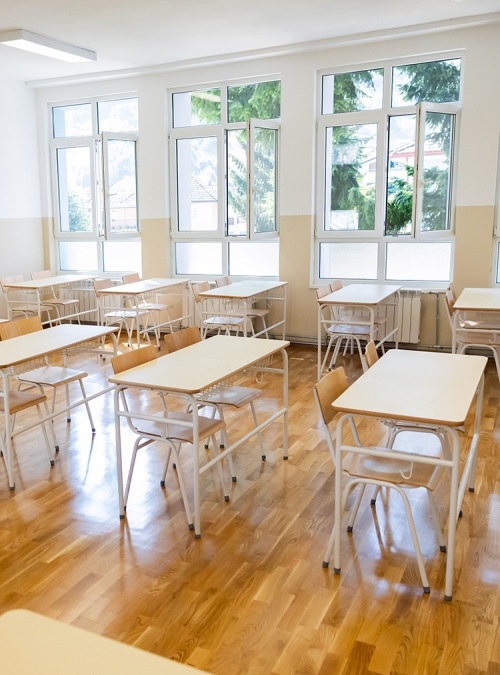
Two more public schools in Montenegro have been given a new, energy-efficient lease of life. The Ministry of Energy and Mining of Montenegro has completed the energy renovation of the "Risto Ratković" and "Vladislav Ribnikar" primary schools in Bijelo Polje, delivered under the project "Promotion of Energy Efficiency in Public Buildings of Montenegro". Both schools form part of the project, carried out within the Regional Energy Efficiency Programme (REEP) for the Western Balkans, with financial support from the European Union and the German development bank KfW, and a contribution from the Government of Montenegro.
To mark the completion of the works, Minister of Energy and Mining Admir Šahmanović visited both schools, toured the renovated buildings, and spoke with pupils, teachers and local community members about the investment's importance for Bijelo Polje. Together, the two schools give the town two fully reconstructed educational buildings in the same cluster, showing that the programme is delivering visible results in several locations at once. "Through this energy efficiency project we are building a Montenegro that changes the way it treats public infrastructure — we do not wait for a building to fall into disrepair, we invest proactively in quality. Bijelo Polje today gets what every child in Montenegro deserves: schools that are warm, healthy and modern. Behind every figure on energy savings there is a child who will no longer sit in a cold classroom and a teacher who can focus on teaching. This is the green transition in its most human form — it begins with our children and our schools."
Works that change the face of a school
The renovation of each school covered a comprehensive package of measures aligned with EU energy-efficiency standards. Works on "Risto Ratković" began in September 2025, alongside those on the neighbouring "Vladislav Ribnikar". In both buildings, structural rehabilitation — including renewal of roof structures and waterproofing and repair of the façade — was combined with a full set of energy measures:
- Thermal insulation of external walls, floors and roof structures;
- Replacement of worn single-glazed windows and doors with new, high-performance joinery;
- Modernisation of heating and cooling systems, with a shift to more environmentally friendly energy sources;
- Installation of LED lighting;
- Reconstruction of sanitary facilities in line with accessibility standards for persons with disabilities.
Part of a growing portfolio of renovated schools
The Bijelo Polje schools are the latest public buildings to be modernised under the project. Seven schools in Kotor, Nikšić, Podgorica, Cetinje and Bar have already been renovated, with the following results:
- Energy savings averaging 59% (3,230 MWh per year);
- A reduction in CO₂ emissions of around 69% — approximately 1,400 tonnes per year;
- Better learning and working conditions for around 5,627 pupils and staff;
- A total investment of some €16.4 million in those seven buildings.
The renovated buildings include "Njegoš" primary school in Kotor; the School of Economics and Hospitality and the University "DIF" building in Nikšić; the "25. maj" grammar school in Podgorica; the "Lovćenski partizanski odred" primary school, the grammar school and "Petar Lubarda" art school in Cetinje; and the "Srbija" and "Jugoslavija" primary schools in Bar.
Schools as pillars of the green transition
Schools are not just buildings — they are places where the values and character of future generations are shaped. That is why public educational institutions sit at the heart of the programme to green public infrastructure. When young people learn and grow every day in a building that uses less energy, emits less carbon and offers a healthy indoor environment, they become living proof that the green transition is possible and tangible. Investing in the energy efficiency of schools is not only technical; it is also educational, showing children that their community takes responsibility for their future and for the health of the planet on which they will live.
About the project
Implemented by the Ministry of Energy and Mining of Montenegro since December 2019, the "Promotion of Energy Efficiency in Public Buildings of Montenegro" (PEEPB) project is part of the Regional Energy Efficiency Programme (REEP), delivered through the Western Balkans Investment Framework. With a total value of around €60 million, it combines a €45 million KfW loan, a €4.8 million EU grant and a €10 million contribution from Montenegro. By December 2027, the project aims to renovate and modernise up to 20 public buildings, covering around 80,000 m², and is expected to save about 7,616 MWh of energy and cut CO₂ emissions by approximately 4,171 tonnes each year.
More information regarding Clean Energy in Montenegro can be found here
---
About REEP
Launched in 2013 under the Western Balkans Investment Framework (WBIF), the Regional Energy Efficiency Programme (REEP) supports renewable energy and energy efficiency investments across the region. With over €1 billion mobilised to date, it has refurbished more than 90 public buildings, supported 1,500 SMEs and 20,000 households. The achieved annual CO₂ emissions saved is equivalent to removing 183,000+ cars from the roads.
---
About WBIF and Global Gateway
The Western Balkans Investment Framework (WBIF) contributes directly to Global Gateway, the EU's strategy to boost smart, clean and secure connections in digital, energy and transport, while strengthening health, education and research systems worldwide. Global Gateway aims to mobilise up to €300 billion worldwide in investments through a Team Europe approach, bringing together the EU, its Member States and financial institutions to leverage investments for a transformational impact.