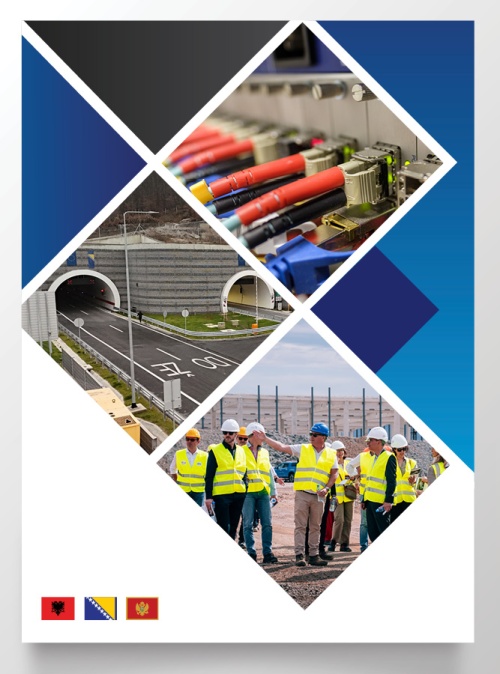
European Commission reviews progress of key EU-supported investments in the Western Balkans
From 25 to 29 May 2026, a team from the European Commission's Directorate-General for Enlargement and the Eastern Neighbourhood (DG ENEST) travelled to the Western Balkans on a monitoring mission to review implementation of key investments financed by the Western Balkans Investment Framework.
The mission covered Bosnia and Herzegovina, Montenegro and Albania, combining high-level discussions on the status of the WBIF portfolio with sector-specific technical meetings on transport, energy, digital, and the environment.Site visits to a selection of projects gave a first-hand view of how European funding is improving quality of life across the Western Balkans.
Bosnia and Herzegovina
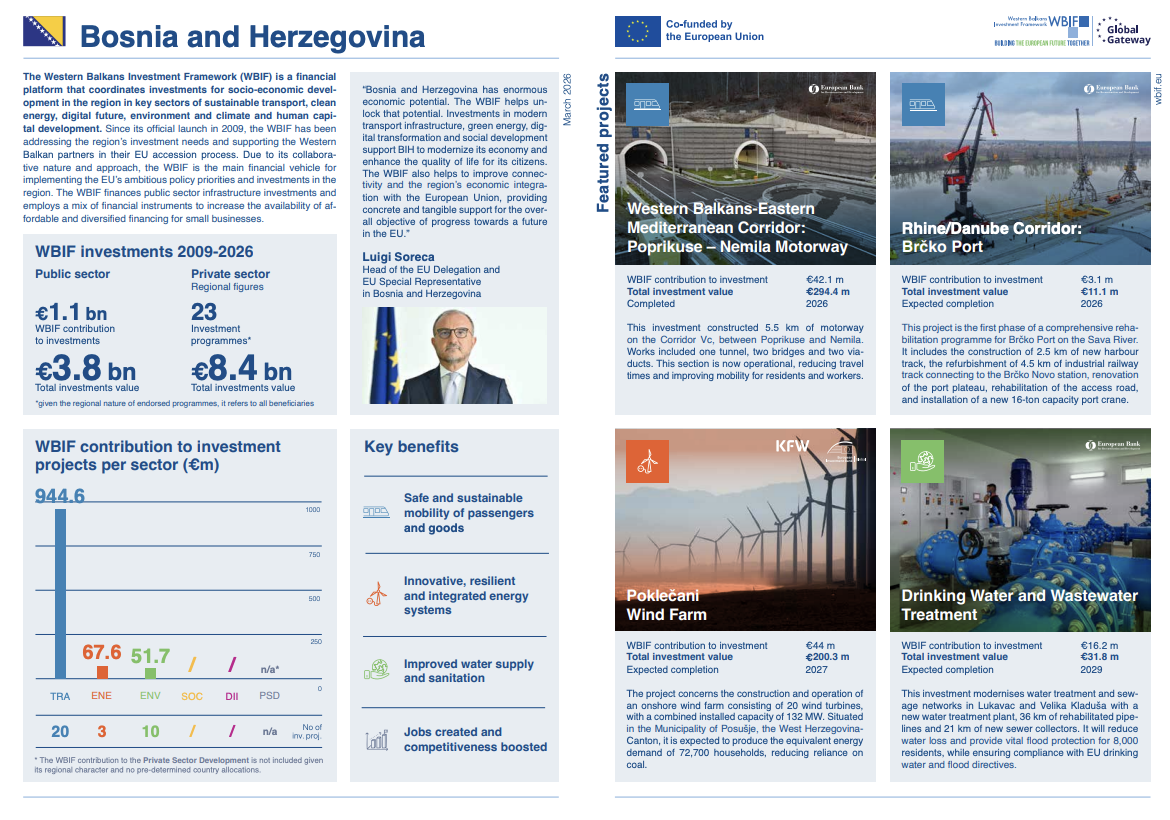
Since 2009, the EU, through the WBIF, has contributed €1.1 billion to 33 infrastructure investment projects in Bosnia and Herzegovina.
During a high-level meeting on 25 May 2026, DG ENEST met with representatives of ministries at different levels of government in Bosnia and Herzegovina:
- At the federal level, the Ministry of Communication and Transport, Ministry of Foreign Trade and Economic Relations, Ministry of Finance and the NIPAC Office
- For the Federation of Bosnia and Herzegovina, the Cabinet of the Prime Minister of FBiH, Ministry of Energy, Mining and Industry, Ministry of Agriculture, Water Management and Forestry
- For the Republika Srpska entity, Ministry of Energy and Mining, Ministry of Agriculture, Forestry and Water Management
Together with WBIF partner financial institutions - the European Investment Bank (EIB), the European Bank for Reconstruction and Development (EBRD), the World Bank Group (WB) and KfW – DG ENEST reviewed the state of implementation of the EU-supported projects and discussed how progress could be accelerated by removing key obstacles.
Transport and clean energy remain central priorities
Transport accounts for the largest share of the portfolio, both in number of projects and in investment volume, notably along the Corridor Vc. Part of the Western Balkans–Eastern Mediterranean European transport corridor, Corridor Vc connects Bosnia and Herzegovina with Hungary, eastern Croatia and the Croatian port of Ploče on the Adriatic Sea. A meeting with representatives of Autoceste FBiH, the public motorway company, reviewed projects currently under implementation along this strategic route, as well as others receiving WBIF technical assistance for project preparation.
Clean energy projects were the focus of a second meeting with representatives of the public electricity utilities Elektroprivreda BiH (EP BiH) and Elektroprivreda HZHB (EP HZHB). Discussions focused on wind power plant investments in Poklečani and Vlašić.
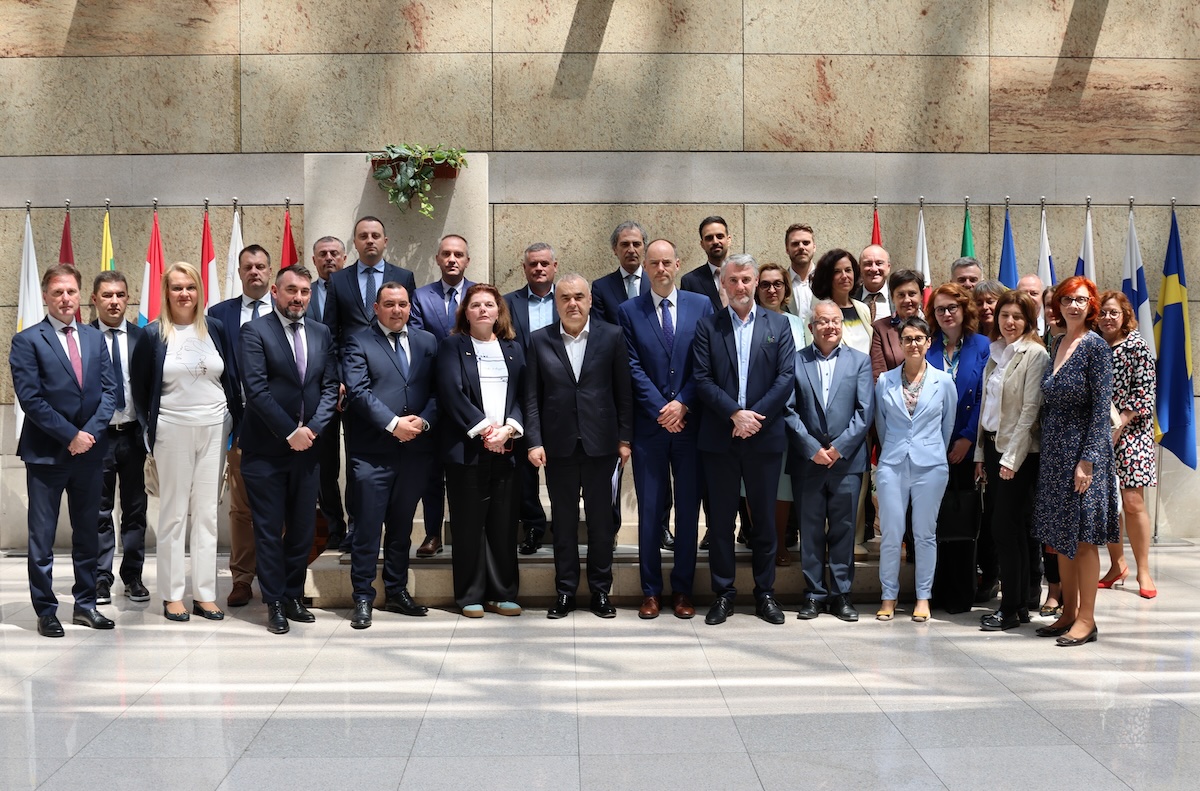
Bosnia and Herzegovina group photo
Persistent obstacles slow implementation
The main areas where progress is still needed include finalising a financing plan to close the gap in the Federation of Bosnia and Herzegovina, removing obstacles to funding motorway projects along Corridor Vc.; resolving the state property issue affecting already tendered and ongoing contracts (Corridor Vc) and likely to block the implementation of critical approved ones (wind farms); resolving administrative delays in issuing permits or ratifying key documents; diversifying portfolio to avoid overconcentration of funding in transport.
The mission concluded with visits to three projects: the Istočna Ilidža water supply system, hosted by the town's mayor, a kindergarten renovated under the Regional Energy Efficiency Programme (REEP), hosted by the Ministry of Education, and the water supply system for the City of Sarajevo, all offering examples of the tangible benefits to the population of the country.
More information regarding projects in Bosnia and Herzegovina can be found in the factsheet below
Montenegro
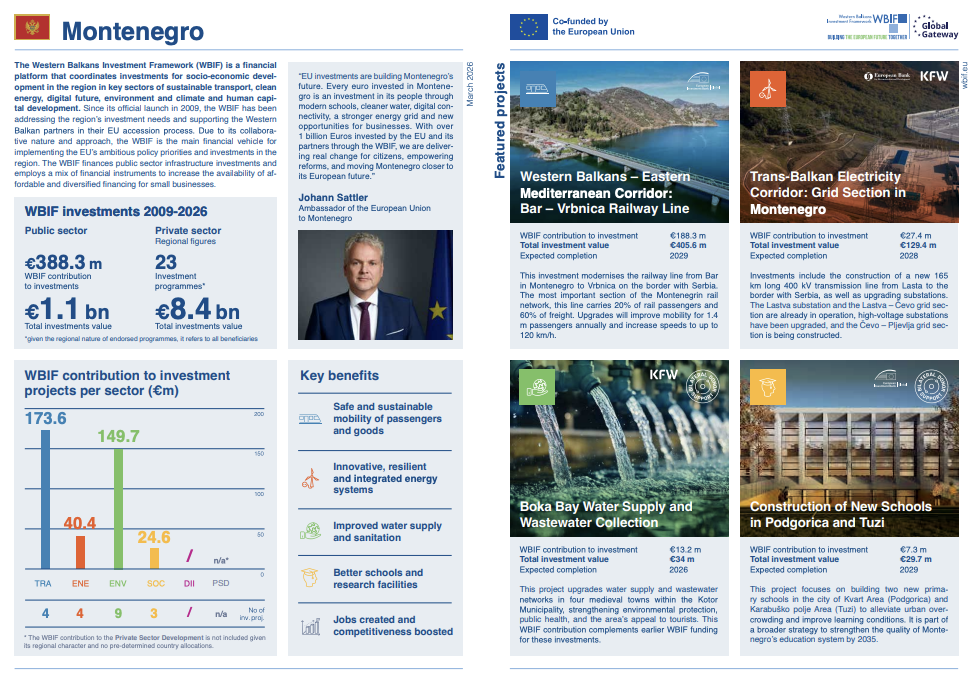
On 27 May 2026, the delegation met in Podgorica with officials from several ministries, including European affairs, finance, transport, energy and mining, and ecology, sustainable development and northern region development, as well as representatives of the WBIF partner financial institutions EIB, EBRD, KfW, World Bank and Agence Francaise de Developpement (AFD). The meeting reviewed the state of implementation of the €388 million portfolio across 20 public sector projects.
Strategic projects in rail, energy and environment
Dedicated meetings on transport, environment and energy projects focused on strategic investments such as the four sections of the Bar–Vrbnica railway line on the Western Balkans–Eastern Mediterranean European transport corridor, the Trans-Balkan Electricity Corridor and wastewater treatment plants.
A visit to the Podgorica wastewater treatment plant highlighted how the new facility and sewerage network will reduce the discharge of untreated wastewater into the Morača River and improve wastewater collection for more than 230,000 residents.
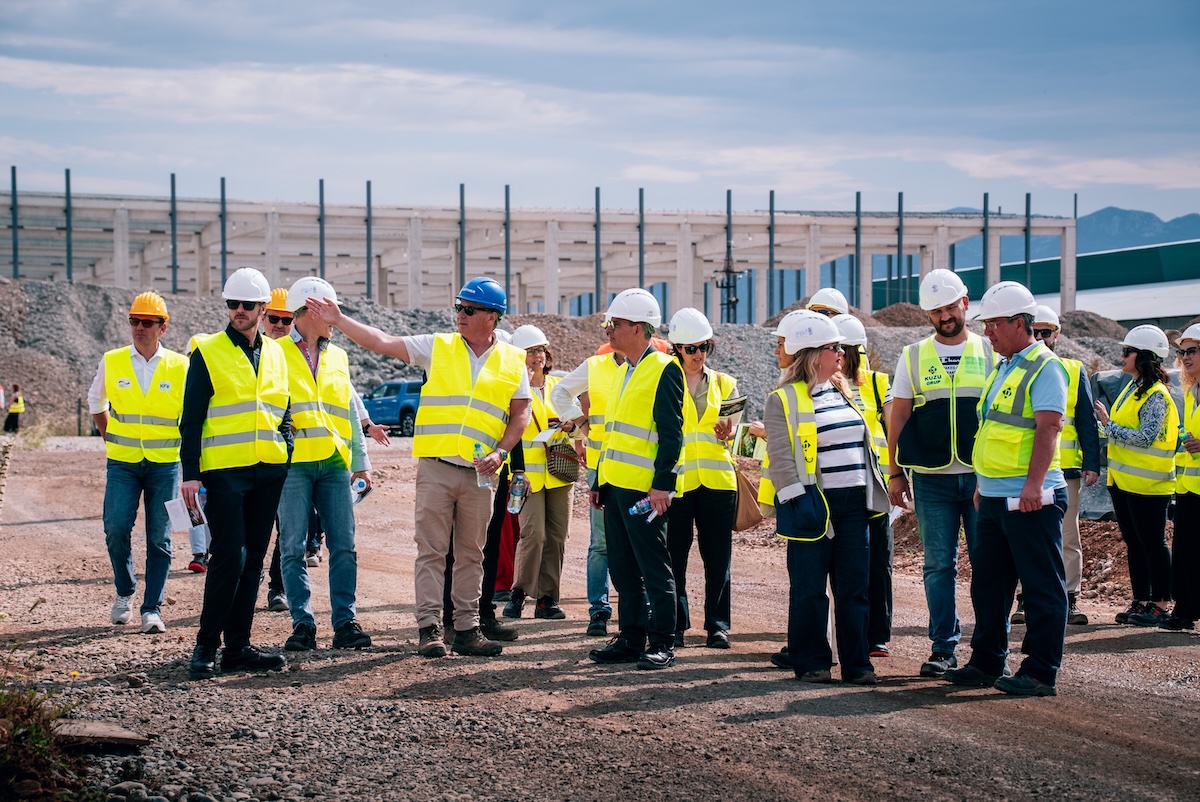
Podgorica Wastewater Treatment Plant site visit
Better project preparation and coordination are needed
The mission concluded that steady progress on infrastructure projects will require improvements in bringing large-scale investment projects to maturity level in a more efficient way in line with international standards as well as better coordination between stakeholders to ensure effective use of funds; tackling administrative delays in completing land expropriation and compensation procedures, obtaining necessary permits as well as resolving issue of disposal of state property; avoiding further overconcentration of funding dedicated to transport sector; and better prioritisation of investments relating to the accession process, notably in the area of environment.
More information regarding projects in Montenegro can be found in the factsheet below
Albania
The final stop of the mission was Tirana, where a high-level meeting on the WBIF portfolio brought together representatives of the Ministry of Finance, the Ministry of Infrastructure and Energy, Albanian Railways (HSH), SASPAC, the Albanian Power Corporation (KESH), the National Agency for Information Society (AKSHI), the Transmission System Operator (OST) and WBIF partner financial institutions EBRD, KfW and AFD on 29 May 2026.
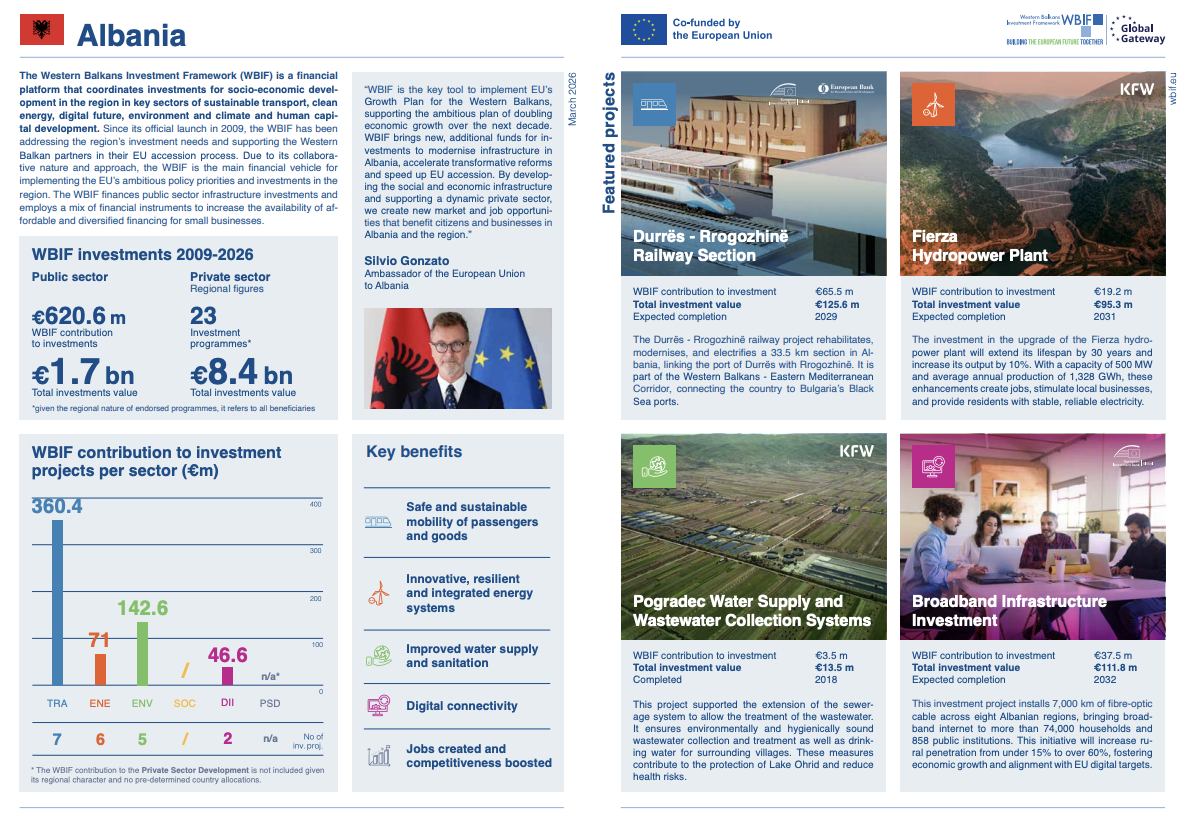
Since 2009, more than €600 million has been invested in public sector projects in Albania across the transport, energy, environment and digital sectors. Discussions pointed to progress across the WBIF portfolio in Albania but also showed that key challenges continue to delay implementation, including procurement bottlenecks and coordination gaps.
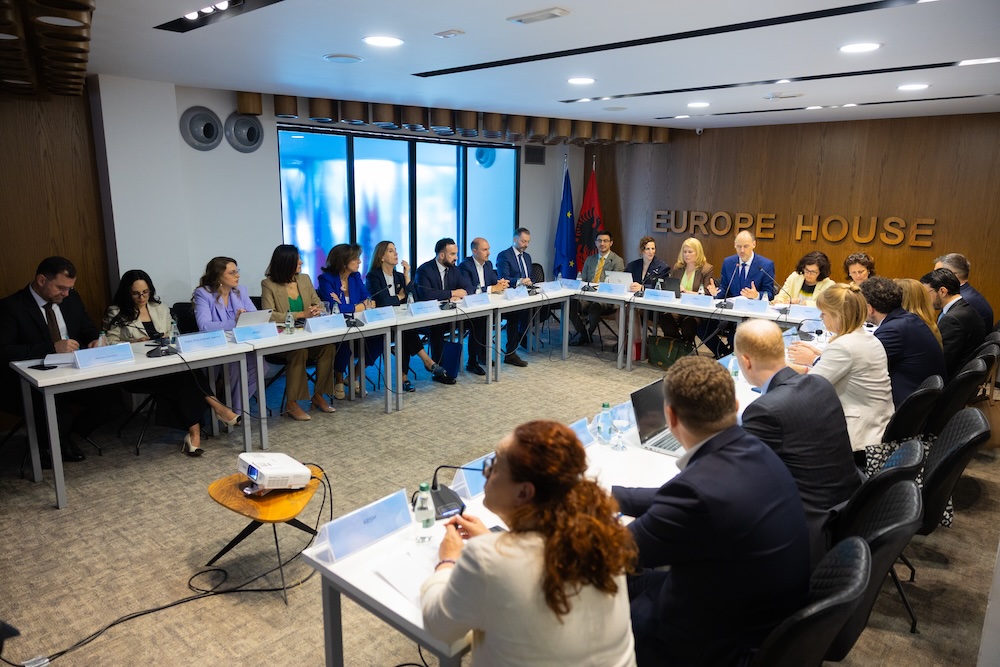
Europe House meeting
Digital, energy and transport investments under review
A first meeting focused on the establishment of Smart Labs in Albanian schools, an ambitious initiative to create computer labs for more than 190,000 schoolchildren. The discussion centred on the complex process of preparing and launching the tender for this major investment.
Meetings on transport and energy rounded off the visit, focusing on the solar photovoltaic power plants in Vau i Dejës and Belshi, as well as the grid section of the power interconnection between Albania and North Macedonia. In both sectors, land acquisition continues to affect implementation timelines and therefore results on the ground. Across the board, it is important to simplify national procedures for the signature and ratification of loan and grant agreements and avoid frequent changes in project scope, priorities or implementation arrangements. Ensuring capacity, particularly in the rail projects pipeline, is a key consideration going forward.
Stronger coordination is key
The visit to the three countries underscored the need for stronger coordination, improved and accelerated preparation of the investments and more streamlined procurement and implementation procedures, supported by targeted assistance from international financial institutions.
More information regarding projects in Albania can be found in the factsheet below
---
About WBIF and Global Gateway
The Western Balkans Investment Framework (WBIF) contributes directly to Global Gateway, the EU's strategy to boost smart, clean and secure connections in digital, energy and transport, while strengthening health, education and research systems worldwide. Global Gateway aims to mobilise up to €300 billion worldwide in investments through a Team Europe approach, bringing together the EU, its Member States and financial institutions to leverage investments for a transformational impact.