Cleaner heat for Serbian cities as biomass investment enters new phase
Belgrade/Prijepolje, 1 July 2026 – Cleaner air, more secure heating and a stronger local renewable energy market are at the centre of a new EUR 31.9 million investment now getting under way in Serbia. The Ministry of Mining and Energy of the Republic of Serbia, with support from KfW, the European Union and the Government of the Federal Republic of Germany, has launched the second phase of the project "Development of the Biomass Market in the Republic of Serbia". Running until 2029, the investment will expand the use of renewable energy in district heating systems in several Serbian cities, providing citizens with more reliable and environmentally sound heating.
"The Biomass II project confirms Serbia's commitment to the energy transition in the district heating sector. Relying on domestic biomass strengthens the country's energy security, reduces dependence on fossil fuels and builds greater resilience to external shocks and disruptions in energy markets. Phasing out heavy fuel oil and coal in heating plants is one of our priorities, because it improves air quality in communities that face excessive pollution during the heating season, while also stimulating local economic development by engaging domestic companies in the wood biomass supply chain," said Maja Vujadinović, Assistant Minister of Mining and Energy for Energy Efficiency and Climate Change.
The first phase of the project, implemented from 2018 to 2024 and valued at EUR 27 million, introduced modern biomass heating plants in Priboj, Mali Zvornik, Novi Pazar and Majdanpek. It delivered major emissions reductions, cutting carbon dioxide by 87% to 95% and sulphur dioxide by up to 100% in some systems, while helping replace imported fossil fuels with domestic renewable energy sources.
"For Prijepolje, this is a historic step forward: cleaner air for our citizens, more reliable and stable heating, and a strong boost to the development of our local community. The project creates new jobs, stimulates the local economy and leaves a legacy for future generations. We are grateful to our partners for the trust they have placed in our municipality and proud that Prijepolje is becoming an example of responsible environmental stewardship," said Drago Popadić, President of the Municipality of Prijepolje.
"Novi Pazar recognised the potential of renewable energy in the first phase of the project, and we are now going one step further. By expanding the heating plant and introducing solar energy, we are providing citizens with cleaner and more secure heating. This is an investment in a healthier environment, stronger energy security for our city and the economic development of the community, as well as in raising awareness of the importance of renewable energy sources," said Nihat Biševac, Mayor of Novi Pazar.
In this second phase, Prijepolje, Novi Pazar, Knjaževac and several other cities will benefit from new investments. In Prijepolje, planned works include a new 6 MW biomass heating plant, around 3,255 metres of distribution network, the replacement of 43 substations and equipment for wood-chip production. In Novi Pazar, the existing heating plant will be expanded with a new 5 MW boiler and a solar facility. Overall, the second phase is expected to generate around 55,000 MWh of renewable energy each year and cut greenhouse gas emissions by about 20,000 tonnes of CO₂ equivalent annually.
"The European Union supports the biomass market development project because it reflects what we strive for in the Western Balkans: tangible benefits for citizens, a cleaner environment and closer alignment with European standards in the energy sector," said Boris Ilijevski of the Delegation of the European Union to the Republic of Serbia.
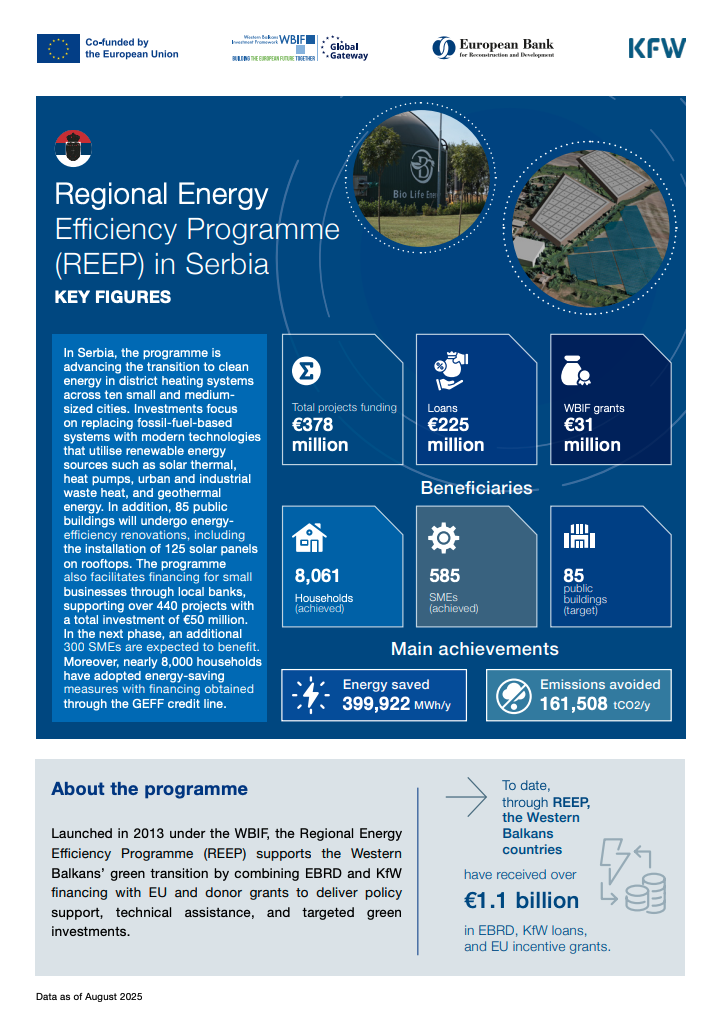
The project is part of the Regional Energy Efficiency Programme, delivered through the Western Balkans Investment Framework, which supports energy efficiency and renewable energy investments across the Western Balkans. Since its launch in 2013, in cooperation with the European Bank for Reconstruction and Development (EBRD) and KfW, the programme has built an investment portfolio of EUR 1 billion and continues to support the region's green transition, including through an additional EUR 88 million approved for future investments.
Read more about REEP in Serbia
---
About REEP
Launched in 2013 under the Western Balkans Investment Framework (WBIF), the Regional Energy Efficiency Programme (REEP) supports renewable energy and energy efficiency investments across the region. With over €1 billion mobilised to date, it has refurbished more than 90 public buildings, supported 1,500 SMEs and 20,000 households. The achieved annual CO₂ emissions saved is equivalent to removing 183,000+ cars from the roads.
---
About WBIF and Global Gateway
The Western Balkans Investment Framework (WBIF) contributes directly to Global Gateway, the EU's strategy to boost smart, clean and secure connections in digital, energy and transport, while strengthening health, education and research systems worldwide. Global Gateway aims to mobilise up to €300 billion worldwide in investments through a Team Europe approach, bringing together the EU, its Member States and financial institutions to leverage investments for a transformational impact.